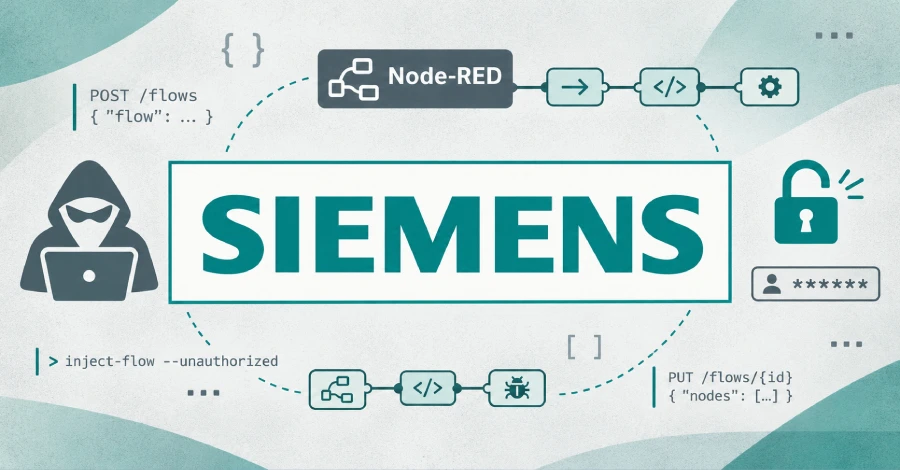
Attackers are actively exploiting a critical Siemens IoT2050 flaw, CVE-2026-58115, on SIMATIC IoT2050 Advanced devices, according to VulnCheck. Siemens and the U.S. Cybersecurity and Infrastructure Security Agency said the bug is a missing authentication issue in the Node-RED HTTP interface that lets an unauthenticated remote attacker create malicious flows and run arbitrary code with maximum privileges, and the National Vulnerability Database lists it with a CVSS score of 10.0.
Key Points
- VulnCheck saw live exploitation of CVE-2026-58115 on October 30, 2026, after Siemens and CISA published advisories on August 11.
- The flaw affects Siemens SIMATIC IoT2050 Advanced devices with Node-RED installed on Industrial OS versions earlier than 4.3.4.1.
- Observed attacks used Node-RED to run commands, download payloads, and in some cases leave a web-based backdoor for later access.
- Siemens says users should update to V4.3.4.1 or later and harden Node-RED, while CISA says the devices should not be exposed directly to the internet.
What is affected
Siemens ProductCERT said SIMATIC IoT2050 Advanced devices running Industrial OS with Node-RED installed contain a missing authentication vulnerability in the Node-RED HTTP interface. CISA restated that the affected devices do not enforce authentication on the Node-RED HTTP interface, which gives unauthenticated access to programming nodes that can execute system commands on the server.
CISA lists the affected product as SIMATIC IoT2050 Advanced, model 6ES7647-0BA00-1YA2, on versions earlier than 4.3.4.1. NVD says all versions earlier than V4.3.4.1 are affected when they run Industrial OS with Node-RED installed. Siemens positions the device for IoT environments, and CISA said the issue affects organizations in the chemical, critical manufacturing, energy, and transportation systems sectors.
How the attacks worked
Siemens and CISA published their advisory on August 11, 2026. VulnCheck said it published detection for CVE-2026-58115 on October 27 and then saw an in-the-wild attack on October 30, three days later.
According to VulnCheck, a single attacker request was enough to deploy a Node-RED flow, trigger it automatically, and download and run a Linux bot behind three layers of encoding. VulnCheck said the flow used an inject node and an exec node, which let the command run as soon as the flow was deployed with no further interaction.
VulnCheck said one decoded sample saved its binary as /dev/shm/.b. The company said /dev/shm is a RAM-backed tmpfs, which means nothing is written to disk, and the leading dot hides the file from a plain ls listing. VulnCheck said the dropper pulled the file from 85.215.73[.]250 on port 8080 and tried wget first and curl as a fallback.
VulnCheck said later activity from the same source IP used a two-stage method that fetched a script named wget.sh from 85.215.73[.]250:8080 and executed it from /tmp/.s. The company also saw another request that used curl or wget against http://45.194.90[.]57:38472/.sys_update, saved the result as /tmp/.kworker, and ran it with nohup.
Several observed requests did not download a payload at all, according to VulnCheck. Instead, they deployed a flow with an HTTP endpoint such as /cmd or a random path and wired it through a function node to an exec node so the attacker could run commands later by sending them in a query parameter. VulnCheck said this kind of backdoor can survive even if a memory-backed implant is lost on reboot.
VulnCheck said it did not retrieve or analyze the bot binary, wget.sh, or .kworker, so it made no claims about what those payloads do. The company said it saw 16 events from the same IP against this CVE and 125 hits from that address against eight different CVEs in recent days.
VulnCheck said the exploit source was 4.201.105.116 in AS8075, Microsoft’s network, geolocated to Brazil, and that the broad activity pattern matched opportunistic mass scanning rather than a targeted attack.
Fixes and checks
Siemens said it released a new version for SIMATIC IoT2050 Advanced and strongly recommends updating Industrial OS to the fixed release. CISA lists the vendor fix as V4.3.4.1 or later. Siemens also said users should harden the Node-RED installation and follow general operational security guidance.
Siemens’ mitigation guidance says users can uninstall Node-RED or harden it by protecting the editor and admin API with credential-based authentication or an OAuth/OpenID provider and by securing HTTP Nodes and the Node-RED Dashboard with basic authentication.
CISA said organizations should minimize network exposure for control systems, keep them off the public internet, place them behind firewalls, and isolate them from business networks.
VulnCheck said it published detection artifacts on October 27, including an exploit proof of concept, a version scanner, a PCAP, Suricata, Snort, and YARA rules, a Docker container, and queries for Shodan, Censys, GreyNoise, FOFA, and ZoomEye. SentinelOne said defenders should look for unexpected new or changed Node-RED flows, HTTP POST requests to Node-RED admin endpoints such as /flows, outbound connections from the Node-RED process to unfamiliar hosts, and unauthorized exec or function nodes in deployed flows.
About the Author