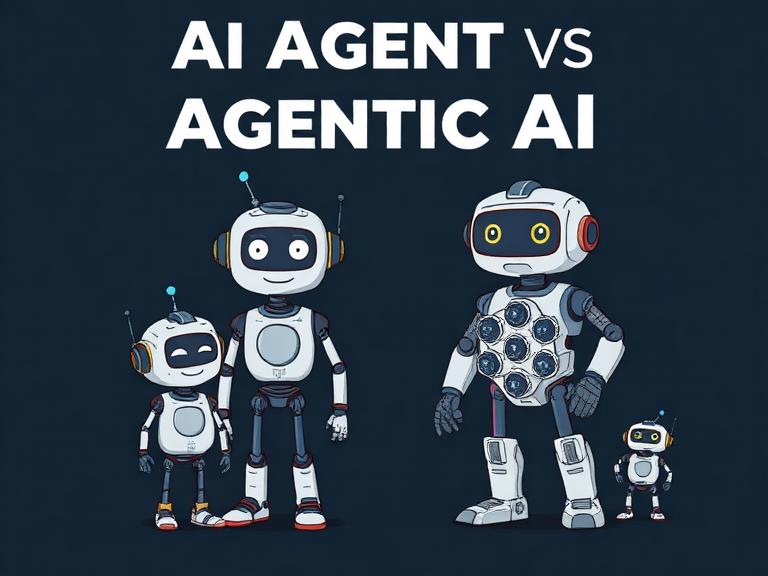
ai agent vs agentic ai
If you have been reading AI news recently, you have probably seen the words AI agent and agentic AI many times. Many people, even skilled developers, use these two terms as if they mean the same thing. But they are not the same.
Understanding the difference is not just a matter of vocabulary. It has real consequences for how you build, deploy, and secure AI systems. In this post, I will break it down in plain English, with examples from tools you likely already use, like Claude, OpenAI, and LangChain.
1. What Is an AI Agent?
An AI agent is a program that uses a large language model (LLM) to complete a specific task. You give it a goal, it figures out the steps, uses some tools, and gets the job done.
Think of it like hiring a contractor for a single project. They have a defined scope of work, use specific tools, and hand back the result when they are done.
A Simple Example
Let us say you are using Claude and you ask it to: “Read this CSV file and give me a sales summary.”
Claude will look at the file, process the data, and write a summary. That is an AI agent in action — one task, one tool, done.
In technical terms, an AI agent typically has:
- An LLM as its brain (like Claude, GPT-4, or Gemini)
- A set of tools it can use (like web search, code execution, or file reading)
- A single task or goal to complete
- A short memory that lasts only for that conversation
# A basic AI agent using Claude's tool-use feature
import anthropic

client = anthropic.Anthropic()

tools = [
    {
        "name": "read_csv",
        "description": "Read and parse a CSV file",
        "input_schema": {
            "type": "object",
            "properties": {"file_path": {"type": "string"}}
        }
    }
]

response = client.messages.create(
    model="claude-opus-4-6",
    max_tokens=1024,
    tools=tools,
    messages=[{"role": "user", "content": "Summarize the sales data in report.csv"}]
)
This is a contained, predictable system. The agent does its job and stops. It does not go off and do things you did not ask for.
2. What Is Agentic AI?
Agentic AI is a bigger concept. It refers to a system where one or more AI agents work together — often without much human involvement — to achieve a complex, long-term goal.
Instead of one contractor, imagine a whole team: a project manager, a researcher, a writer, and a quality checker — all AI, all working together and passing work between each other automatically.
What Makes a System “Agentic”?
A system is considered agentic when it has most of these qualities:
- Long-term planning: It breaks down a big goal into many smaller steps and works through them over time.
- Multiple agents working together: One agent manages others, each with a specific role.
- Persistent memory: It remembers things across different sessions or conversations.
- Self-correction: If something goes wrong, it tries a different approach on its own.
- Minimal human oversight: It operates largely on autopilot once you set it in motion.
A Simple Example
Imagine you tell an agentic AI system: “Research our competitors, write a report, and send it to the team by Friday.”
The system might:
- Spin up a Research Agent that browses the web and reads articles
- Pass those findings to a Writer Agent that drafts the report
- Send it through an Editor Agent for quality checks
- Finally, use an Email Agent to send it out
You set the goal. The system handles everything else. That is agentic AI.
Simple way to remember it: An AI agent is like a single employee. Agentic AI is like an entire team with its own workflow.
3. Key Differences at a Glance
| Feature | AI Agent | Agentic AI |
|---|---|---|
| Scope | One task at a time | Long, multi-step goals |
| Memory | Short-term only | Persistent across sessions |
| Number of agents | Just one | Multiple, working together |
| Human involvement | Present at each step | Minimal, mostly automated |
| Tool usage | Fixed, pre-defined tools | Can create and use tools dynamically |
| Predictability | Easy to predict | Harder to predict, emergent behavior |
| Security risk | Contained | Can cascade across systems |
4. Real-World Examples with Claude, OpenAI, and More
Let us look at how some popular AI tools fit into these two categories.
Claude by Anthropic
Claude is a great example of both concepts depending on how you use it.
When you open Claude.ai and ask it to help you rewrite an email — that is an AI agent interaction. One task, one response, done.
But when developers use Claude Code — which lets Claude browse files, run code, fix bugs, and iterate — it starts entering agentic AI territory. It is making decisions across multiple steps with minimal hand-holding.
Anthropic also introduced the Model Context Protocol (MCP), which is designed to help AI agents communicate with external tools and other agents more safely. This is a building block for agentic AI.
OpenAI Agents SDK
OpenAI’s Agents SDK (released in early 2025) makes it straightforward to build agentic systems. It introduces a concept called “handoffs,” where one agent can pass a task to another mid-workflow.
# OpenAI multi-agent handoff — a real agentic AI pattern
from agents import Agent, handoff

research_agent = Agent(
    name="Researcher",
    instructions="Search the web and gather relevant information",
    tools=[web_search]
)

writer_agent = Agent(
    name="Writer",
    instructions="Take research findings and write a clear report",
    tools=[send_email]
)

# Agent 1 finishes, passes work to Agent 2 automatically
pipeline = handoff(from_agent=research_agent, to_agent=writer_agent)
This is a clean and powerful pattern, but as we will see next, it also introduces security concerns.
LangChain and CrewAI
Frameworks like LangChain and CrewAI make it easy to build agentic systems with defined roles. In CrewAI, you literally assign job titles like Researcher, Analyst, Writer to different agents, and they collaborate on a shared goal.
Google Gemini
Google’s Gemini supports function calling (essentially tool use), which puts it in the AI agent category for most use cases. With Gemini 2.0, Google is pushing further toward more autonomous, agentic behavior, especially inside Google Workspace.
5. Security Risks You Should Know About
This is where the distinction really matters. A single AI agent has a contained risk profile. But agentic AI systems with multiple agents, persistent memory, and broad tool access have a much larger attack surface.
Here are the most important risks to understand:
Prompt Injection — The #1 Threat
Prompt injection happens when someone hides malicious instructions inside content that the AI reads like a document, email, or web page. The AI then follows those hidden instructions as if they were legitimate.
In a single AI agent, this is bad but contained. In an agentic system, the injected instruction can travel between agents. Agent A reads a poisoned document. It passes the content to Agent B. Agent B which has email access follows the hidden instruction and forwards sensitive data to an attacker. Neither agent individually did anything “wrong.” Together, they caused a data breach.
This is called indirect prompt injection propagation, and it is one of the most serious risks in modern agentic deployments. The OWASP LLM Top 10 lists it as a critical vulnerability.
Denial of Wallet
Agentic systems can get stuck in loops — calling APIs over and over. Without a hard limit in place, this can rack up thousands of dollars in API costs overnight. This is sometimes called a “Denial of Wallet” attack. It sounds funny until it happens to you.
Excessive Permissions
Agentic AI systems often need access to many tools like email, databases, file systems, calendars. If you give every agent in the system access to everything, one compromised agent can affect all of them. This violates the basic security principle of least privilege.
Memory Poisoning
Unlike a single agent that forgets everything when the conversation ends, agentic AI systems often use persistent memory (stored in vector databases). An attacker who interacts with the system over multiple sessions could gradually teach it incorrect behavior — behavior that gets embedded in long-term memory and affects all future users.
Summary of Risks
| Risk | AI Agent | Agentic AI | Severity |
|---|---|---|---|
| Prompt Injection | Localized | Can spread across agent chain | Critical |
| Data Exfiltration | Limited to one tool | Can cross multiple systems | High |
| Denial of Wallet | Low — bounded scope | High — runaway agent loops | Medium |
| Memory Poisoning | Not applicable | Persistent database corruption | High |
| Excessive Permissions | Easy to scope | Difficult across many agents | High |
6. How to Stay Safe When Using These Systems
The good news is that the security community is catching up. Here are practical steps you can take, whether you are a developer building these systems or a manager overseeing their use.
Give Each Agent Only What It Needs
Do not create one “super agent” with access to everything. Give each agent in your system only the specific tools it needs for its role. If your Writer Agent does not need database access, do not give it database access. This limits how much damage a compromised agent can do.
Anthropic calls this the “minimum footprint” principle in their agentic AI guidelines.
Sanitize Content Passed Between Agents
Any content that one agent passes to another should be treated like untrusted input. Strip or validate it before it enters the next agent’s context window. This is the most direct way to prevent prompt injection from spreading.
Add Human Checkpoints for High-Stakes Actions
For actions that cannot be undone — sending emails, deleting files, executing transactions — require a human to approve before the agent proceeds. Anthropic specifically recommends building “interrupt mechanisms” into agentic pipelines for irreversible actions.
Set Hard Limits on API Usage
Always configure maximum token limits, API call limits, and cost caps per agent. Set up alerts when usage spikes unexpectedly. This prevents both runaway loops and deliberate denial-of-wallet attacks.
Log Everything
Every agent action should be logged — which agent ran, what tool it called, what input it received, what output it produced. Without this, debugging a failure (or a breach) in an agentic system is nearly impossible. Tools like LangSmith and OpenTelemetry can help here.
Red Team Your System Before Going Live
Try to break your own agentic system before an attacker does. Tools like Garak can automate adversarial prompt injection tests. Run these regularly, not just once at launch.
7. Final Thoughts
Here is the simplest way I can summarize what we covered:
- An AI agent is a single AI system focused on one task. It is predictable, controlled, and relatively easy to secure.
- Agentic AI is a system of AI agents working together autonomously that is powerful, flexible, and much more complex to secure.
Both have their place. For simple, repeatable tasks, a single AI agent is usually the right choice. For complex workflows that involve research, decision-making, and action across multiple systems, agentic AI is where things are heading.
The key is to match your security posture to the system you are actually building. A single-agent security model applied to an agentic system is a bit like locking your front door while leaving every window open.
As tools like Claude, OpenAI’s Agents SDK, and LangChain continue to mature, agentic AI is going to become the norm rather than the exception. Getting comfortable with these concepts now, and building secure foundations, will save you a lot of headaches later.
If you found this helpful, please share 🙂
Further Reading
- OWASP LLM Top 10 — Security risks for LLM applications
- NIST AI Risk Management Framework
- Anthropic — Claude Tool Use Documentation
- Model Context Protocol (MCP) — Anthropic
- Garak — LLM Red Teaming Framework
- OpenAI Agents SDK Overview
About the Author