
Debian and Ubuntu have published advisories for CVE-2026-109518, an APT flaw that lets an attacker on the network path swap a package after APT has verified it and then run attacker-controlled code as root. The attack works by altering HTTP package downloads and depends on APT retrying failed downloads, a behavior that is enabled by default starting with Debian 12 and Ubuntu 22.04.
Key Points
- Debian, Ubuntu, and Linux distributions derived from them are affected because they use APT for package updates.
- An attacker who can change HTTP traffic, such as a malicious mirror, proxy, or someone on the same network path, can turn a normal update into a root-level compromise.
- Default installations are exposed on Debian 12 and newer and Ubuntu 22.04 and newer because APT retries failed downloads there by default.
- Debian has released fixes, and the advisories do not describe any known in-the-wild exploitation so far.
- Administrators are being advised to update APT, use trusted networks, and prefer HTTPS mirrors where possible.
How the flaw works
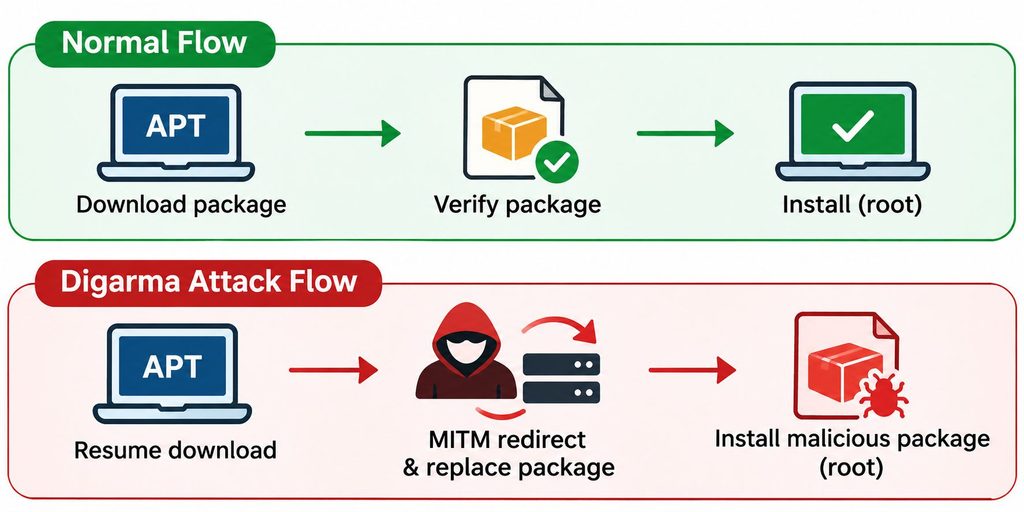
According to advisories published by Debian, Ubuntu, and the APT developers on November 4, the bug is in how APT handles resumed downloads over HTTP. Debian security advisory DSA-6607-1 said a resumed HTTP download could be redirected and merged with another package’s URI, which lets a man-in-the-middle attacker inject code that then runs as root.
The core issue is in APT’s resume-and-redirect logic rather than in APT’s signature checking itself. When APT resumes an interrupted download, it handles the file incorrectly and opens a short window in which the package can be replaced after it has already been verified.
Attackers can use HTTP redirects and ordinary temporary server errors to force APT to retry the download. The vulnerability is caused by the reuse of hard links and requires the client to follow redirects and retry package downloads.
Who is affected
The flaw affects Debian, Ubuntu, and derivative Linux distributions that use APT. An attacker can be anyone who can change the HTTP traffic between an APT client and the archive server, including a malicious mirror or proxy.
The attack only works when the Acquire::Retries setting is above zero. That value is 3 by default starting with Debian 12, also called bookworm, and Ubuntu 22.04 LTS, also called Jammy Jellyfish, so older releases are not affected in a default configuration.
Debian 12 and later and Ubuntu 22.04 and later are exposed by default because retries are enabled there. The advisories describe the attack over HTTP and do not say whether package sources reached over HTTPS are exposed.
Patches and severity
Ubuntu rates CVE-2026-109518 as high priority with a CVSS 4.0 score of 7.7. APT’s developers call the flaw critical.
Debian has released fixed versions of APT. The fix lands in APT 3.0.4 for trixie, while Debian 11 received version 2.2.5 even though long-term support for that release ended on August 31.
The upstream project fixed the issue in APT 3.3.6 by changing the download methods to open target files exclusively, which stops two downloads from touching the same file. The flaw was reported by Max Justicz, a software engineer and security researcher.
Current status and mitigation
None of the Debian, Ubuntu, or APT developer advisories described exploitation in the wild. The official advisories did not provide a workaround for systems that cannot be updated immediately.
Administrators should run apt update and apt upgrade on trusted networks and confirm that the installed APT version matches the fixed release for their system. HTTPS mirrors are preferable because they make interception harder.
As a temporary step on unpatched systems, setting Acquire::Retries to 0 removes one of the conditions needed for the attack, although it can make updates less reliable on poor connections. Other listed mitigation measures include enforcing HTTPS for package downloads, disabling hard link reuse in APT configuration, and updating APT to the latest secure version.
About the Author